
One of our activities in South Florida, is attending the numerous local festivals. Some of these I've written about in past blogs, so I'll concentrate on some of the recent ones.

On the second saturday in February, the
Sour Orange festival takes place in the town of Lakeport. This is one of the smaller festivals. You can try one of their delicacies, sour orange pie.
LAKEPORT, FL. -- The harvest of the rare sour orange is cause for a yearly celebration in a small fishing resort on the north shore of Lake Okeechobee. Sour oranges are prolific in this remote wilderness region, the ancient trees growing wild in cattle pastures and homesteads. The tropical fruit once grew all over the state but due to development was purposely destroyed. Only in pastoral Florida will you find so many of these treasured trees.
If you love sour oranges, this is the place to be. You can taste and purchase sour orange pies, sour orange BBQ sauce Caribbean style, and sour oranges at Lakeport's Sour Orange Festival on Saturday, February 11th from 8 a.m. to 4 p.m.
Prepare yourself for a simple festival in a tree-shaded park. The commercialism and noise of most festivals is absent. It is more akin to an old-fashioned community picnic where half the people in attendance know each other. Long time residents meet up here after not having seen each other for a time; local politicians are out slapping backs; snowbirds living in local RV parks bring their folding chairs to sit in the community park and listen to local bands play from the outdoor stage.
You can wander casually through a few rows of vendors and encounter hard working artisans selling their own special handmade products, or talk to members of civic groups who get a space for free.
In 1992, locals decided to celebrate the origins and unique culinary uses of the sour orange with this one-of-a-kind annual festival as a fundraiser. The original Sour Orange Cookbook, published by the Lakeport Community Association in 1992, speaks of the traditional uses of sour oranges by the Gladesmen who hunted the wild hogs in the hammocks near Lake Okeechobee. "There are two traditions that must be observed when roasting wild hog in Lakeport," it states. "First it is considered to be a man's job (and the men definitely hold bragging rights to how well they can cook pork); second, basting of the hog with the juice of the Sour Orange is essential." However, locals have found basting fish and chicken with the juice is very satisfying, too. In fact recipes using lemons can be substituted with sour oranges.
Brought here by the Spanish in their colonial period, sour orange trees have historical roots. Sour oranges were once the original rootstock for the creation of the sweet oranges that created the huge citrus industry in Florida.
Sour oranges are still grown commercially in Spain to make marmalade in Britain, sour orange peels make candies in Puerto Rico and the Mojito of Cuba is a zesty mixture of sour orange juice, garlic and other herbs, according to the cookbook. Liqueurs such as Cointreau, Grand Marnier and Curacao are made with sour oranges.
During the day, fun contests and games for both children and adults take place keeping the restless busy. The Sour Orange Bake-off and the Sour Orange Pie Eating contest are traditions, as well as a raffle of many intriguing items, including the winning pastries, jellies or specialty foods.
Tourists who happen to see a flyer about the festival or read about it in a local paper, come out of curiosity to taste the sour orange. They also get a taste of the friendly folks of old Florida. Nothing hectic, no crowds, just real laid back and simple entertainment making it a lovely no-headache day.


One the first saturday in february, you can attend the Ortona
Cane Grinding Festival in the Ortona Mounds. You can view an ancient mechanical grinding of sugar cane. You can purchase or sample some of the cane syrup produced from the process. It tastes a bit like molasses.
Ortona Mounds
While less than a mile long, this walk in the woods in the ranchlands of Glades County takes you back to a time more than 3,000 years, well before the Calusa paddled the Caloosahatchee in their canoes and settled here too. The original complex is about the same age as the Miami Circle. The Calusa were known for building canals, and here near Turkey Creek, this settlement had an extensive canal system and a large number of mounds, including the highest point in Glades County at 22 feet above sea level. Only a portion of the original complex is left today, but this interpretive trail leads you through the hammocks and scrub to see these ancient mounds and canals.
Ortona Cane Grinding Festival, held the first weekend in February.
There are picnic pavilions and playground equipment in the shady oak hammock where the trail begins, and a covered picnic table in a pretty spot along the hike.


 Seafood Festival
-Everglades City. This is one of the largest festivals. Very crowded. You can sample Conch Fritters, as well as a host of other seafood delicacies.
"The original Everglades Seafood Festival happened because the city bought this land and wanted to build a park," says Marya Repko, President of the Everglades City Historical Society, adding, "We had a fish fry to raise money for the playground equipment." Since that original fish fry, the event has grown exponentially.


In mid-february, the Brighton Rodeo takes place. You can try out fried bread and other native dishes. The festival is run by the Seminole Tribe. Here is a bit of trivia about the Seminole:
Survival In The Swamp
The
Seminoles began the 20th century where they had been left at the conclusion of the Seminole Wars - in abject poverty, hiding out in remote camps in the wet wilderness areas of South Florida. There, finally left at peace from U.S. government oppression, the last few Florida Indians managed to live off the land, maintaining minimal contact with the outside world. Hunting, trapping, fishing and trading with the white man at frontier outposts provided the Seminoles with their only significant economic enterprise of the era.
By this time, development had reached the coastal rivers and plains of South Florida. Inland, a "drain-the-Everglades" mentality promoted by politicians and developers, forever altered the course of the "River of Grass." Even in the untamed wilderness of the Seminole, man's social and ecological pollution had dire effect. Poor crops, shrinking numbers of fish and game, droughts, serious hurricanes and other calamities once again heaped pressure on the Seminoles.
The collapse of the frontier Seminole economy in the 1920s threatened the Florida Indians with assimilation and extinction. The wilderness no longer offered salvation; many lived as tenants on lands or farms where they worked or as spectacles in the many tiny tourist attractions sprouting up across tourist South Florida.
By this time, however, the U.S. Congress had begun to take notice. By 1938, more than 80,000 acres of land had been set aside for the Seminoles in the Big Cypress, Hollywood and Brighton areas and the invitation to move in, to change from subsistence farming and hunting/trapping to an agriculture-based economy, was offered. Few Seminoles moved onto these Indian reservation lands, however, mistrusting the government that had hunted their forebears. Even the religious missionaries had a tough time breaking through the determined Seminole spirit.
In 1934, Congress passed the Indian Reorganization Act, recognizing the rights of American Indians to conduct popular vote elections and govern their own political affairs by constitution and bylaws. Again, inherently suspicious, mistrustful of any government intervention, the Seminoles did not take advantage of this opportunity until 23 years later when the Tribe was faced with official termination by the U.S. Government. They did, however, file a petition with the U.S. Indian Claims Commission in 1947 for a settlement to cover their lands lost to the U.S. government aggressors.

The
Swamp Cabbage festival is held on the last weekend in February. You can sample Gator Fritters, and Swamp Cabbage.
The LaBelle Swamp Cabbage Festival is held every year on the last full weekend in February in LaBelle at Barron Park.
It is a local celebration (parade, music, food, entertainment) to honor the official state tree, the sabal (cabbage) palm, by eating it. The heart of the cabbage palm is prepared into swamp cabbage or fritters (each a southern Florida Cracker vegetable delicacy) and the focus of the celebration. So, if you've got a hankering for swamp cabbage or just want to see what it looks like... or taste it, then this festival is for you.
The festival was started back in 1965. Old Man Riggs (being a 1969 graduate of LaBelle High) remembers the first Swamp Cabbage Festival and had the honor of being classmates with the first of the Swamp Cabbage Queens ever to exist. Yee Hah!
The Swamp Cabbage parade begins at 10:00 am Saturday morning and contains lots of home-grown floats decorated with swamp cabbage palm fronds. Immediately following, we all crowd into the park and sample the southern "swamp" cuisines and listen to live music at the main stage in the park.
The festival usually features around a 100 booths vending crafts and foods.Typically there are armadillo races and a rodeo.

Chalo Nitka is a small town rodeo and festival held in MooreHaven.
Chalo Nitka History
A Brief History of Chalo Nitka: Seminole for "Big Bass," Chalo Nitka is a festival that originated in 1948 to celebrate the paving of then Main Street in Moore Haven. Since that time, the Annual Chalo Nitka Festival has evolved into what it is today, a week-long series of events that showcase the southern hospitality of Glades County and our friends from the Seminole Tribe of Florida. Now one of Florida's oldest continuous festivals, Chalo Nitka has turned into Glades County's fair with events sure to delight everyone. From livestock shows to alligator wrestling, to a ranch rodeo, Chalo Nitka is the place to be the first weekend in March. For more information on the festival's events please see the schedule as it gets closer to the date. We hope you stop by and enjoy Chalo Nitka and get a sense of the natural beauty Glades County and Moore Haven have to offer.
Glades County History
Named partly for the Florida Everglades, Glades County is located on the southwest edge of Lake Okeechobee in South Florida and was developed in 1921. On the bank of the largest freshwater lake in Florida, Glades County is a rural county known mostly for its primarily agricultural land use for citrus, sugar cane, and other crop production. Also, since Glades County is connected with Lake Okeechobee, eco-tourism is a draw for many bird watchers and amateur/professional fisherman because of some of the best bass fishing in the world. The total area of Glades County is 986 square miles with 774 square miles being land and 213 square miles comprised of water. The population of Glades County is approximately 11,100 including Moore Haven, named after founder, James A. Moore. Also, the Caloosahatchee River runs through Glades County which is part of Florida's Intracoastal Waterway. There are five unincorporated communities in Glades County: Buckhead Ridge, Lakeport, Ortona, Palmdale, and Muse along with the Brighton Seminole Indian Reservation located in northeast Glades County, home to the Brighton Seminole Casino.
Glades County residents appreciate nature which is evident in the rich history and traditions that have been present for generations. Recreational opportunities are abundant in Glades County, whether visiting The Lake Okeechobee Scenic Trail which winds its way through the county, canoeing at Fisheating Creek, visiting Gatorama, or taking advantage of the numerous hunting and fishing opportunities Glades County has to offer.


Speckcled Perch Festival is held in Okeechobee Florida around the second weekend in March. You can try your hand at fried pickles and various fried fish.
Since its inception in 1965, the Speckled Perch festival has provided entertainment and festivities for the city and our visitors, including the annual Speckled Perch parade and rodeo at the Agri-Civic Center. The Speckled Perch Festival will be held this year on March 9th and 10th, kicking off the week of the Okeechobee County Fair. Visitors will enjoy the ambiance of our small, rural setting and city murals in the midst of craft and specialty vendors, the aroma of festival goodies and local musical entertainment. The Speckled Perch parade which will begin at 11:00 am on Saturday, March 9th, will showcase our newly crowned Speckled Perch Queen, Junior Miss, Princess, Little Miss and MIster and Tiny Miss and Mister and their respective courts. This is an opportunity to leave the stress and traffic of the city, relax with friends and stroll through the town.




 We also took in a bit of beach and Spring Training baseball between the Blue Jays and the Minnesota Twinns.


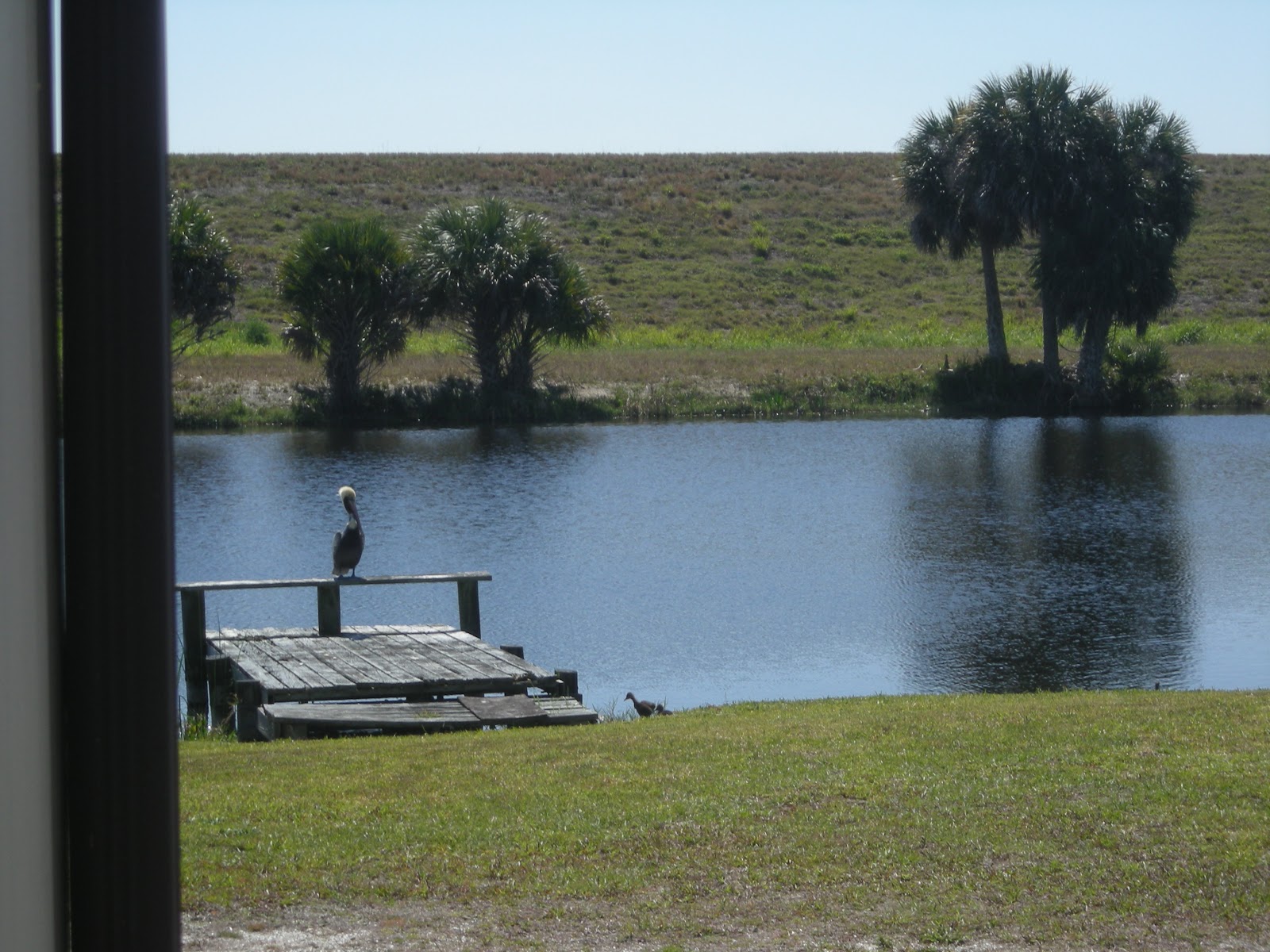
 After spending 8 winters in Florida, we've seen our share of wildlife. This year has been particularly active
We encountered a multitude of gators, one who's found a permanent home under our dock. We encountered a bobcat while taking a morning walk on the Okeechobee levies. We have a bald headed american eagle outside our home on a daily basis.
After spending 8 winters in Florida, we've seen our share of wildlife. This year has been particularly active
We encountered a multitude of gators, one who's found a permanent home under our dock. We encountered a bobcat while taking a morning walk on the Okeechobee levies. We have a bald headed american eagle outside our home on a daily basis.


 We've encountered wild pigs, snakes, armadillos, deer, turtles, and a host of florida fowl, most of witch, right on our property. We don't always carry our camera, but, Here are a few pictures:

 .
.
 Florida's holy land, the town of Ave Maria.
 Ave Maria is a fledgling town that was once a tomato field.
The 5,000-acre town the religious vision of Domino's Pizza tycoon Tom Monaghan. It's between Naples and Immokalee. It takes 20 minutes to reach Interstate 75 if you ignore the speed limit.
It's so remote that conservative commentator Rush Limbaugh's radio show crackles with static on the AM dial, reports the St. Petersburg Times.
There is a Monaghan museum it the office of Ave Maria Development, overseer of the entire project. Monaghan's credo stares down from a display: "I believe my mission is to get as many people to heaven as possible."
Ave Maria's projected population of 11,000 stands at about 500.
The town is home to one of Florida’s most impressive modern churches. Its interior steel-beam vaulting rises 104 feet. You can see it from miles away.
Ave Maria is a fledgling town that was once a tomato field.
The 5,000-acre town the religious vision of Domino's Pizza tycoon Tom Monaghan. It's between Naples and Immokalee. It takes 20 minutes to reach Interstate 75 if you ignore the speed limit.
It's so remote that conservative commentator Rush Limbaugh's radio show crackles with static on the AM dial, reports the St. Petersburg Times.
There is a Monaghan museum it the office of Ave Maria Development, overseer of the entire project. Monaghan's credo stares down from a display: "I believe my mission is to get as many people to heaven as possible."
Ave Maria's projected population of 11,000 stands at about 500.
The town is home to one of Florida’s most impressive modern churches. Its interior steel-beam vaulting rises 104 feet. You can see it from miles away.
 Monaghan wants to give the massive 1,100-seat church to the Diocese of Venice.
But the Catholic bishop is reluctant to assume the upkeep, including the frightening air conditioning demands. Big church, so few parishioners.
The town's coffee shop is called the Bean and there are pictures of the Virgin Mary on the wall.
The Bean serves up conservative sentiments on its cups: "Tolerance without conviction is the same as apathy" — Chesterton.
But thank God they do serve a cold beer.
The Bean serves bottled beer in a town without a grocery, at least until the Publix opens this summer. And an English-style pub is opening soon. It's called the Queen Mary after England's 16th-century Catholic monarch.
For those who like living in a religious retreat-like environment we say "AMEN!"
Founder's goals.
Monaghan wants to give the massive 1,100-seat church to the Diocese of Venice.
But the Catholic bishop is reluctant to assume the upkeep, including the frightening air conditioning demands. Big church, so few parishioners.
The town's coffee shop is called the Bean and there are pictures of the Virgin Mary on the wall.
The Bean serves up conservative sentiments on its cups: "Tolerance without conviction is the same as apathy" — Chesterton.
But thank God they do serve a cold beer.
The Bean serves bottled beer in a town without a grocery, at least until the Publix opens this summer. And an English-style pub is opening soon. It's called the Queen Mary after England's 16th-century Catholic monarch.
For those who like living in a religious retreat-like environment we say "AMEN!"
Founder's goals.
 In a May 2004 speech, Monaghan expressed his wish to have the new town and university campus be free from pre-marital sex, contraceptives, abortion, pornography and gay rights. This elicited sharply critical statements from the international press, who saw such proposed restrictions as violations of civil liberties. Howard Simon, executive director of the American Civil Liberties Union branch in Florida, challenged the legality of the restriction of sales of contraceptives. He said, "This is not just about the sale of contraceptives in the local pharmacy, it is about whether in an incorporated town there will be a fusion of religion and government." An opinion column in The Wall Street Journal quoted an Ave Maria faculty member who exaggeratedly called it a "Catholic Jonestown". Frances Kissling of Catholics for Choice compared Monaghan's civic vision to Islamic fundamentalism, and called it "un-American". In response, Monaghan announced a milder form of civic planning in which the town could mostly grow on its own, except that it would not have sex shops or strip clubs, and store owners would be asked rather than ordered not to sell contraceptives or porn. Contraception and porn would still be banned from the university.
 One of our activities in South Florida, is attending the numerous local festivals. Some of these I've written about in past blogs, so I'll concentrate on some of the recent ones.
 On the second saturday in February, the Sour Orange festival takes place in the town of Lakeport. This is one of the smaller festivals. You can try one of their delicacies, sour orange pie.
LAKEPORT, FL. -- The harvest of the rare sour orange is cause for a yearly celebration in a small fishing resort on the north shore of Lake Okeechobee. Sour oranges are prolific in this remote wilderness region, the ancient trees growing wild in cattle pastures and homesteads. The tropical fruit once grew all over the state but due to development was purposely destroyed. Only in pastoral Florida will you find so many of these treasured trees.
If you love sour oranges, this is the place to be. You can taste and purchase sour orange pies, sour orange BBQ sauce Caribbean style, and sour oranges at Lakeport's Sour Orange Festival on Saturday, February 11th from 8 a.m. to 4 p.m.
Prepare yourself for a simple festival in a tree-shaded park. The commercialism and noise of most festivals is absent. It is more akin to an old-fashioned community picnic where half the people in attendance know each other. Long time residents meet up here after not having seen each other for a time; local politicians are out slapping backs; snowbirds living in local RV parks bring their folding chairs to sit in the community park and listen to local bands play from the outdoor stage.
You can wander casually through a few rows of vendors and encounter hard working artisans selling their own special handmade products, or talk to members of civic groups who get a space for free.
In 1992, locals decided to celebrate the origins and unique culinary uses of the sour orange with this one-of-a-kind annual festival as a fundraiser. The original Sour Orange Cookbook, published by the Lakeport Community Association in 1992, speaks of the traditional uses of sour oranges by the Gladesmen who hunted the wild hogs in the hammocks near Lake Okeechobee. "There are two traditions that must be observed when roasting wild hog in Lakeport," it states. "First it is considered to be a man's job (and the men definitely hold bragging rights to how well they can cook pork); second, basting of the hog with the juice of the Sour Orange is essential." However, locals have found basting fish and chicken with the juice is very satisfying, too. In fact recipes using lemons can be substituted with sour oranges.
Brought here by the Spanish in their colonial period, sour orange trees have historical roots. Sour oranges were once the original rootstock for the creation of the sweet oranges that created the huge citrus industry in Florida.
Sour oranges are still grown commercially in Spain to make marmalade in Britain, sour orange peels make candies in Puerto Rico and the Mojito of Cuba is a zesty mixture of sour orange juice, garlic and other herbs, according to the cookbook. Liqueurs such as Cointreau, Grand Marnier and Curacao are made with sour oranges.
During the day, fun contests and games for both children and adults take place keeping the restless busy. The Sour Orange Bake-off and the Sour Orange Pie Eating contest are traditions, as well as a raffle of many intriguing items, including the winning pastries, jellies or specialty foods.
Tourists who happen to see a flyer about the festival or read about it in a local paper, come out of curiosity to taste the sour orange. They also get a taste of the friendly folks of old Florida. Nothing hectic, no crowds, just real laid back and simple entertainment making it a lovely no-headache day.
On the second saturday in February, the Sour Orange festival takes place in the town of Lakeport. This is one of the smaller festivals. You can try one of their delicacies, sour orange pie.
LAKEPORT, FL. -- The harvest of the rare sour orange is cause for a yearly celebration in a small fishing resort on the north shore of Lake Okeechobee. Sour oranges are prolific in this remote wilderness region, the ancient trees growing wild in cattle pastures and homesteads. The tropical fruit once grew all over the state but due to development was purposely destroyed. Only in pastoral Florida will you find so many of these treasured trees.
If you love sour oranges, this is the place to be. You can taste and purchase sour orange pies, sour orange BBQ sauce Caribbean style, and sour oranges at Lakeport's Sour Orange Festival on Saturday, February 11th from 8 a.m. to 4 p.m.
Prepare yourself for a simple festival in a tree-shaded park. The commercialism and noise of most festivals is absent. It is more akin to an old-fashioned community picnic where half the people in attendance know each other. Long time residents meet up here after not having seen each other for a time; local politicians are out slapping backs; snowbirds living in local RV parks bring their folding chairs to sit in the community park and listen to local bands play from the outdoor stage.
You can wander casually through a few rows of vendors and encounter hard working artisans selling their own special handmade products, or talk to members of civic groups who get a space for free.
In 1992, locals decided to celebrate the origins and unique culinary uses of the sour orange with this one-of-a-kind annual festival as a fundraiser. The original Sour Orange Cookbook, published by the Lakeport Community Association in 1992, speaks of the traditional uses of sour oranges by the Gladesmen who hunted the wild hogs in the hammocks near Lake Okeechobee. "There are two traditions that must be observed when roasting wild hog in Lakeport," it states. "First it is considered to be a man's job (and the men definitely hold bragging rights to how well they can cook pork); second, basting of the hog with the juice of the Sour Orange is essential." However, locals have found basting fish and chicken with the juice is very satisfying, too. In fact recipes using lemons can be substituted with sour oranges.
Brought here by the Spanish in their colonial period, sour orange trees have historical roots. Sour oranges were once the original rootstock for the creation of the sweet oranges that created the huge citrus industry in Florida.
Sour oranges are still grown commercially in Spain to make marmalade in Britain, sour orange peels make candies in Puerto Rico and the Mojito of Cuba is a zesty mixture of sour orange juice, garlic and other herbs, according to the cookbook. Liqueurs such as Cointreau, Grand Marnier and Curacao are made with sour oranges.
During the day, fun contests and games for both children and adults take place keeping the restless busy. The Sour Orange Bake-off and the Sour Orange Pie Eating contest are traditions, as well as a raffle of many intriguing items, including the winning pastries, jellies or specialty foods.
Tourists who happen to see a flyer about the festival or read about it in a local paper, come out of curiosity to taste the sour orange. They also get a taste of the friendly folks of old Florida. Nothing hectic, no crowds, just real laid back and simple entertainment making it a lovely no-headache day.
 One the first saturday in february, you can attend the Ortona Cane Grinding Festival in the Ortona Mounds. You can view an ancient mechanical grinding of sugar cane. You can purchase or sample some of the cane syrup produced from the process. It tastes a bit like molasses.
Ortona Mounds
While less than a mile long, this walk in the woods in the ranchlands of Glades County takes you back to a time more than 3,000 years, well before the Calusa paddled the Caloosahatchee in their canoes and settled here too. The original complex is about the same age as the Miami Circle. The Calusa were known for building canals, and here near Turkey Creek, this settlement had an extensive canal system and a large number of mounds, including the highest point in Glades County at 22 feet above sea level. Only a portion of the original complex is left today, but this interpretive trail leads you through the hammocks and scrub to see these ancient mounds and canals.
Ortona Cane Grinding Festival, held the first weekend in February.
There are picnic pavilions and playground equipment in the shady oak hammock where the trail begins, and a covered picnic table in a pretty spot along the hike.
One the first saturday in february, you can attend the Ortona Cane Grinding Festival in the Ortona Mounds. You can view an ancient mechanical grinding of sugar cane. You can purchase or sample some of the cane syrup produced from the process. It tastes a bit like molasses.
Ortona Mounds
While less than a mile long, this walk in the woods in the ranchlands of Glades County takes you back to a time more than 3,000 years, well before the Calusa paddled the Caloosahatchee in their canoes and settled here too. The original complex is about the same age as the Miami Circle. The Calusa were known for building canals, and here near Turkey Creek, this settlement had an extensive canal system and a large number of mounds, including the highest point in Glades County at 22 feet above sea level. Only a portion of the original complex is left today, but this interpretive trail leads you through the hammocks and scrub to see these ancient mounds and canals.
Ortona Cane Grinding Festival, held the first weekend in February.
There are picnic pavilions and playground equipment in the shady oak hammock where the trail begins, and a covered picnic table in a pretty spot along the hike.

 Seafood Festival-Everglades City. This is one of the largest festivals. Very crowded. You can sample Conch Fritters, as well as a host of other seafood delicacies.
"The original Everglades Seafood Festival happened because the city bought this land and wanted to build a park," says Marya Repko, President of the Everglades City Historical Society, adding, "We had a fish fry to raise money for the playground equipment." Since that original fish fry, the event has grown exponentially.
Seafood Festival-Everglades City. This is one of the largest festivals. Very crowded. You can sample Conch Fritters, as well as a host of other seafood delicacies.
"The original Everglades Seafood Festival happened because the city bought this land and wanted to build a park," says Marya Repko, President of the Everglades City Historical Society, adding, "We had a fish fry to raise money for the playground equipment." Since that original fish fry, the event has grown exponentially.


 In mid-february, the Brighton Rodeo takes place. You can try out fried bread and other native dishes. The festival is run by the Seminole Tribe. Here is a bit of trivia about the Seminole:
Survival In The Swamp
The Seminoles began the 20th century where they had been left at the conclusion of the Seminole Wars - in abject poverty, hiding out in remote camps in the wet wilderness areas of South Florida. There, finally left at peace from U.S. government oppression, the last few Florida Indians managed to live off the land, maintaining minimal contact with the outside world. Hunting, trapping, fishing and trading with the white man at frontier outposts provided the Seminoles with their only significant economic enterprise of the era.
By this time, development had reached the coastal rivers and plains of South Florida. Inland, a "drain-the-Everglades" mentality promoted by politicians and developers, forever altered the course of the "River of Grass." Even in the untamed wilderness of the Seminole, man's social and ecological pollution had dire effect. Poor crops, shrinking numbers of fish and game, droughts, serious hurricanes and other calamities once again heaped pressure on the Seminoles.
The collapse of the frontier Seminole economy in the 1920s threatened the Florida Indians with assimilation and extinction. The wilderness no longer offered salvation; many lived as tenants on lands or farms where they worked or as spectacles in the many tiny tourist attractions sprouting up across tourist South Florida.
By this time, however, the U.S. Congress had begun to take notice. By 1938, more than 80,000 acres of land had been set aside for the Seminoles in the Big Cypress, Hollywood and Brighton areas and the invitation to move in, to change from subsistence farming and hunting/trapping to an agriculture-based economy, was offered. Few Seminoles moved onto these Indian reservation lands, however, mistrusting the government that had hunted their forebears. Even the religious missionaries had a tough time breaking through the determined Seminole spirit.
In 1934, Congress passed the Indian Reorganization Act, recognizing the rights of American Indians to conduct popular vote elections and govern their own political affairs by constitution and bylaws. Again, inherently suspicious, mistrustful of any government intervention, the Seminoles did not take advantage of this opportunity until 23 years later when the Tribe was faced with official termination by the U.S. Government. They did, however, file a petition with the U.S. Indian Claims Commission in 1947 for a settlement to cover their lands lost to the U.S. government aggressors.
In mid-february, the Brighton Rodeo takes place. You can try out fried bread and other native dishes. The festival is run by the Seminole Tribe. Here is a bit of trivia about the Seminole:
Survival In The Swamp
The Seminoles began the 20th century where they had been left at the conclusion of the Seminole Wars - in abject poverty, hiding out in remote camps in the wet wilderness areas of South Florida. There, finally left at peace from U.S. government oppression, the last few Florida Indians managed to live off the land, maintaining minimal contact with the outside world. Hunting, trapping, fishing and trading with the white man at frontier outposts provided the Seminoles with their only significant economic enterprise of the era.
By this time, development had reached the coastal rivers and plains of South Florida. Inland, a "drain-the-Everglades" mentality promoted by politicians and developers, forever altered the course of the "River of Grass." Even in the untamed wilderness of the Seminole, man's social and ecological pollution had dire effect. Poor crops, shrinking numbers of fish and game, droughts, serious hurricanes and other calamities once again heaped pressure on the Seminoles.
The collapse of the frontier Seminole economy in the 1920s threatened the Florida Indians with assimilation and extinction. The wilderness no longer offered salvation; many lived as tenants on lands or farms where they worked or as spectacles in the many tiny tourist attractions sprouting up across tourist South Florida.
By this time, however, the U.S. Congress had begun to take notice. By 1938, more than 80,000 acres of land had been set aside for the Seminoles in the Big Cypress, Hollywood and Brighton areas and the invitation to move in, to change from subsistence farming and hunting/trapping to an agriculture-based economy, was offered. Few Seminoles moved onto these Indian reservation lands, however, mistrusting the government that had hunted their forebears. Even the religious missionaries had a tough time breaking through the determined Seminole spirit.
In 1934, Congress passed the Indian Reorganization Act, recognizing the rights of American Indians to conduct popular vote elections and govern their own political affairs by constitution and bylaws. Again, inherently suspicious, mistrustful of any government intervention, the Seminoles did not take advantage of this opportunity until 23 years later when the Tribe was faced with official termination by the U.S. Government. They did, however, file a petition with the U.S. Indian Claims Commission in 1947 for a settlement to cover their lands lost to the U.S. government aggressors.  The Swamp Cabbage festival is held on the last weekend in February. You can sample Gator Fritters, and Swamp Cabbage.
The LaBelle Swamp Cabbage Festival is held every year on the last full weekend in February in LaBelle at Barron Park.
It is a local celebration (parade, music, food, entertainment) to honor the official state tree, the sabal (cabbage) palm, by eating it. The heart of the cabbage palm is prepared into swamp cabbage or fritters (each a southern Florida Cracker vegetable delicacy) and the focus of the celebration. So, if you've got a hankering for swamp cabbage or just want to see what it looks like... or taste it, then this festival is for you.
The festival was started back in 1965. Old Man Riggs (being a 1969 graduate of LaBelle High) remembers the first Swamp Cabbage Festival and had the honor of being classmates with the first of the Swamp Cabbage Queens ever to exist. Yee Hah!
The Swamp Cabbage parade begins at 10:00 am Saturday morning and contains lots of home-grown floats decorated with swamp cabbage palm fronds. Immediately following, we all crowd into the park and sample the southern "swamp" cuisines and listen to live music at the main stage in the park.
The festival usually features around a 100 booths vending crafts and foods.Typically there are armadillo races and a rodeo.
The Swamp Cabbage festival is held on the last weekend in February. You can sample Gator Fritters, and Swamp Cabbage.
The LaBelle Swamp Cabbage Festival is held every year on the last full weekend in February in LaBelle at Barron Park.
It is a local celebration (parade, music, food, entertainment) to honor the official state tree, the sabal (cabbage) palm, by eating it. The heart of the cabbage palm is prepared into swamp cabbage or fritters (each a southern Florida Cracker vegetable delicacy) and the focus of the celebration. So, if you've got a hankering for swamp cabbage or just want to see what it looks like... or taste it, then this festival is for you.
The festival was started back in 1965. Old Man Riggs (being a 1969 graduate of LaBelle High) remembers the first Swamp Cabbage Festival and had the honor of being classmates with the first of the Swamp Cabbage Queens ever to exist. Yee Hah!
The Swamp Cabbage parade begins at 10:00 am Saturday morning and contains lots of home-grown floats decorated with swamp cabbage palm fronds. Immediately following, we all crowd into the park and sample the southern "swamp" cuisines and listen to live music at the main stage in the park.
The festival usually features around a 100 booths vending crafts and foods.Typically there are armadillo races and a rodeo.
 Chalo Nitka is a small town rodeo and festival held in MooreHaven.
Chalo Nitka History
A Brief History of Chalo Nitka: Seminole for "Big Bass," Chalo Nitka is a festival that originated in 1948 to celebrate the paving of then Main Street in Moore Haven. Since that time, the Annual Chalo Nitka Festival has evolved into what it is today, a week-long series of events that showcase the southern hospitality of Glades County and our friends from the Seminole Tribe of Florida. Now one of Florida's oldest continuous festivals, Chalo Nitka has turned into Glades County's fair with events sure to delight everyone. From livestock shows to alligator wrestling, to a ranch rodeo, Chalo Nitka is the place to be the first weekend in March. For more information on the festival's events please see the schedule as it gets closer to the date. We hope you stop by and enjoy Chalo Nitka and get a sense of the natural beauty Glades County and Moore Haven have to offer.
Glades County History
Named partly for the Florida Everglades, Glades County is located on the southwest edge of Lake Okeechobee in South Florida and was developed in 1921. On the bank of the largest freshwater lake in Florida, Glades County is a rural county known mostly for its primarily agricultural land use for citrus, sugar cane, and other crop production. Also, since Glades County is connected with Lake Okeechobee, eco-tourism is a draw for many bird watchers and amateur/professional fisherman because of some of the best bass fishing in the world. The total area of Glades County is 986 square miles with 774 square miles being land and 213 square miles comprised of water. The population of Glades County is approximately 11,100 including Moore Haven, named after founder, James A. Moore. Also, the Caloosahatchee River runs through Glades County which is part of Florida's Intracoastal Waterway. There are five unincorporated communities in Glades County: Buckhead Ridge, Lakeport, Ortona, Palmdale, and Muse along with the Brighton Seminole Indian Reservation located in northeast Glades County, home to the Brighton Seminole Casino.
Glades County residents appreciate nature which is evident in the rich history and traditions that have been present for generations. Recreational opportunities are abundant in Glades County, whether visiting The Lake Okeechobee Scenic Trail which winds its way through the county, canoeing at Fisheating Creek, visiting Gatorama, or taking advantage of the numerous hunting and fishing opportunities Glades County has to offer.
Chalo Nitka is a small town rodeo and festival held in MooreHaven.
Chalo Nitka History
A Brief History of Chalo Nitka: Seminole for "Big Bass," Chalo Nitka is a festival that originated in 1948 to celebrate the paving of then Main Street in Moore Haven. Since that time, the Annual Chalo Nitka Festival has evolved into what it is today, a week-long series of events that showcase the southern hospitality of Glades County and our friends from the Seminole Tribe of Florida. Now one of Florida's oldest continuous festivals, Chalo Nitka has turned into Glades County's fair with events sure to delight everyone. From livestock shows to alligator wrestling, to a ranch rodeo, Chalo Nitka is the place to be the first weekend in March. For more information on the festival's events please see the schedule as it gets closer to the date. We hope you stop by and enjoy Chalo Nitka and get a sense of the natural beauty Glades County and Moore Haven have to offer.
Glades County History
Named partly for the Florida Everglades, Glades County is located on the southwest edge of Lake Okeechobee in South Florida and was developed in 1921. On the bank of the largest freshwater lake in Florida, Glades County is a rural county known mostly for its primarily agricultural land use for citrus, sugar cane, and other crop production. Also, since Glades County is connected with Lake Okeechobee, eco-tourism is a draw for many bird watchers and amateur/professional fisherman because of some of the best bass fishing in the world. The total area of Glades County is 986 square miles with 774 square miles being land and 213 square miles comprised of water. The population of Glades County is approximately 11,100 including Moore Haven, named after founder, James A. Moore. Also, the Caloosahatchee River runs through Glades County which is part of Florida's Intracoastal Waterway. There are five unincorporated communities in Glades County: Buckhead Ridge, Lakeport, Ortona, Palmdale, and Muse along with the Brighton Seminole Indian Reservation located in northeast Glades County, home to the Brighton Seminole Casino.
Glades County residents appreciate nature which is evident in the rich history and traditions that have been present for generations. Recreational opportunities are abundant in Glades County, whether visiting The Lake Okeechobee Scenic Trail which winds its way through the county, canoeing at Fisheating Creek, visiting Gatorama, or taking advantage of the numerous hunting and fishing opportunities Glades County has to offer.

 Speckcled Perch Festival is held in Okeechobee Florida around the second weekend in March. You can try your hand at fried pickles and various fried fish.
Since its inception in 1965, the Speckled Perch festival has provided entertainment and festivities for the city and our visitors, including the annual Speckled Perch parade and rodeo at the Agri-Civic Center. The Speckled Perch Festival will be held this year on March 9th and 10th, kicking off the week of the Okeechobee County Fair. Visitors will enjoy the ambiance of our small, rural setting and city murals in the midst of craft and specialty vendors, the aroma of festival goodies and local musical entertainment. The Speckled Perch parade which will begin at 11:00 am on Saturday, March 9th, will showcase our newly crowned Speckled Perch Queen, Junior Miss, Princess, Little Miss and MIster and Tiny Miss and Mister and their respective courts. This is an opportunity to leave the stress and traffic of the city, relax with friends and stroll through the town.
Speckcled Perch Festival is held in Okeechobee Florida around the second weekend in March. You can try your hand at fried pickles and various fried fish.
Since its inception in 1965, the Speckled Perch festival has provided entertainment and festivities for the city and our visitors, including the annual Speckled Perch parade and rodeo at the Agri-Civic Center. The Speckled Perch Festival will be held this year on March 9th and 10th, kicking off the week of the Okeechobee County Fair. Visitors will enjoy the ambiance of our small, rural setting and city murals in the midst of craft and specialty vendors, the aroma of festival goodies and local musical entertainment. The Speckled Perch parade which will begin at 11:00 am on Saturday, March 9th, will showcase our newly crowned Speckled Perch Queen, Junior Miss, Princess, Little Miss and MIster and Tiny Miss and Mister and their respective courts. This is an opportunity to leave the stress and traffic of the city, relax with friends and stroll through the town.


